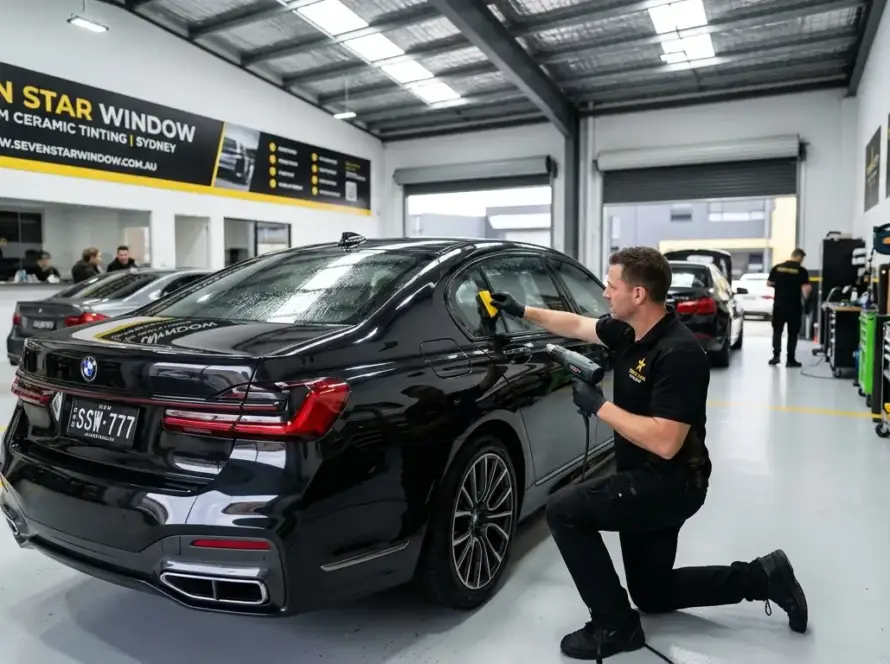
EVs run their heating and cooling off the battery, not a free spinning engine — so every bit of heat that gets through the glass costs you real range. That matters more on a Tesla than almost any other car, because Tesla’s glass roof is enormous and has very little factory heat protection. This guide covers what to tint on a Tesla or other EV, which film to use, and what it costs in Sydney. or explore our professional car window tinting services.
Why EVs Need A Different Tinting Approach
A petrol car loses a lot of cabin heat to a hot engine bay anyway. An EV doesn’t have that problem — or that trade-off. All the solar heat that comes through the glass goes straight into the cabin, and all the energy used to cool it back down comes straight off the battery. On a hot Sydney day, that’s a real hit to your range, not just comfort.
The panoramic glass roof fitted to the Model 3 and Model Y makes this worse. It’s effectively a skylight the size of the whole cabin, with Tesla’s factory glass giving only partial solar protection on its own.
NSW Legal Tint Limits & Performance Standards
When tinting an EV or Tesla in New South Wales, compliance with local laws and choosing the right film metrics matter:
- Front Side Windows: Must comply with NSW regulations requiring a minimum 35% VLT (Visible Light Transmission).
- Rear Windows & Glass Roof: Can use darker films for enhanced privacy and heat reduction, provided dual exterior mirrors are fitted.
- Windscreen: Strictly limited to a non-reflective upper visor strip; full front windscreen tinting is illegal.
- TSER (Total Solar Energy Rejected): Look for high TSER nano-ceramic films rather than just basic IR (Infrared) rejection metrics. A higher TSER rating ensures maximum solar heat rejection, directly reducing AC load and preserving your EV’s driving range on hot Sydney days.
Which Windows to Tint, and What Film to Use
At Seven Star Window, we recommend selecting a premium ceramic film for your Tesla or EV to ensure maximum infrared heat rejection without interfering with internal sensors or exceeding NSW legal limits.
Front side windows: Must stay legal — see NSW rules below. A high-clarity ceramic film is the best option here because it rejects heat without needing a dark shade, so it won’t drop you below the legal VLT.
Rear side windows and rear glass: More room to go darker. Ceramic film is still the better choice over carbon on an EV, because the extra infrared rejection has a direct, measurable effect on cabin temperature and AC load.
Glass roof (Model 3 and Model Y): This is the single highest-value tint on any Tesla. A light ceramic IR film can cut a significant amount of additional heat without visibly darkening the roof — a different product to side-window film, applied as its own panel.
Why ceramic over carbon or dyed for EVs: Ceramic film blocks more infrared heat for the same visible darkness, meaning you don’t need to go dark to get a cooler cabin. It also doesn’t interfere with radio or phone signals, which matters on a car that relies on constant connectivity for software updates, navigation and Autopilot-style features.
Heat and Glare Benefits — Stated Conservatively
Ceramic film on an EV’s glass roof and rear glass meaningfully reduces how hot the cabin gets when parked in the sun, and reduces the amount of work the climate system has to do to bring it back down. It also cuts glare through the large glass area, which matters on a car where you’re looking past wide glass at a screen-based dash rather than analog gauges.
We don’t publish specific range-saved or degree-dropped numbers unless they come from actual testing on a car we’ve worked on — those figures vary too much by model, film and weather to state as a general promise.
NSW Compliance for EV Front Windows
Tesla and other EVs follow the exact same NSW window tint rules as any other car:
- Front side windows: minimum 35% VLT
- Rear side windows and rear glass: minimum 20% VLT
- Windscreen: no film across the main glass, only a non-reflective visor strip on top
- Glass roof: not regulated as a “window” under NSW tint law, since it’s not a side or rear window — but we still use ceramic-only film there for durability and clarity
Film Types Compared for EVs
| Film | Good for EVs? | Why |
| Dyed | Not recommended | Minimal heat rejection — doesn’t address the EV heat/range problem |
| Carbon | Decent | Blocks more heat than dyed, stable colour, but less IR rejection than ceramic |
| Ceramic | Best choice | Highest IR rejection per shade level, no signal interference — the right call for glass-heavy EVs |
Time and Price
Sedan-bodied EVs (like the Model 3) are priced the same as any sedan; SUV-bodied EVs (like the Model Y) as any SUV:
| Package | Starting from |
| Carbon tint, sedan-class EV | $320 |
| Ceramic tint, sedan-class EV | $380 |
| Carbon tint, SUV-class EV | $380 |
| Ceramic tint, SUV-class EV | $420 |
| Glass roof ceramic IR film | Quoted separately — contact us |
Full pricing is on our pricing page. Most EV tint jobs (excluding the glass roof) take one to two hours.
Frequently Asked Questions
Is ceramic tint worth it on a Tesla?
Yes, more so than on a petrol car — the heat you keep out directly affects how much your AC draws from the battery, which affects range.
Can you legally tint a Tesla glass roof dark in NSW?
Yes — the roof isn’t classed as a window under NSW tint law, so it isn’t covered by the 35%/20% VLT rules that apply to side and rear glass.
How much does it cost to tint a Model 3 or Model Y?
Model 3 is priced as a sedan (carbon from $320, ceramic from $380); Model Y as an SUV (carbon from $380, ceramic from $420). Glass roof film is quoted separately.