
Regular highway driving can expose your vehicle’s paintwork to stones, loose road debris, and other impacts. Even a small chip on the bonnet or front bumper can become frustrating, particularly when your car is relatively new. Car paint protection film (PPF) provides a physical barrier over selected painted surfaces, helping reduce damage from everyday road hazards.
For Sydney drivers who regularly travel along routes such as the M2 and M7, choosing the right coverage can make a practical difference. Seven Star Window helps vehicle owners understand different paint protection options. Here, we’ll look at the areas most worth protecting and how to choose coverage that suits your driving habits.
What Is Car Paint Protection Film?
Paint protection film is a transparent or coloured protective layer applied to suitable vehicle surfaces. Many modern films are made from thermoplastic polyurethane (TPU), a flexible material designed to absorb minor impacts and resist everyday surface damage.
Unlike ceramic coating, which provides a protective surface layer, PPF offers a physical barrier between the vehicle’s paint and external hazards.
It can help reduce the risk of:
- Stone chips from loose road debris.
- Minor surface scratches and abrasions.
- Insect marks and certain environmental contaminants.
- Everyday wear on exposed painted panels.
Some premium films also feature self-healing top coats that can reduce the appearance of light surface marks when exposed to heat, depending on the product.
However, PPF is not damage-proof. It cannot guarantee protection against deep scratches, dents, major impacts, or every type of road hazard.
Which Areas Need Car Paint Protection Film Most?
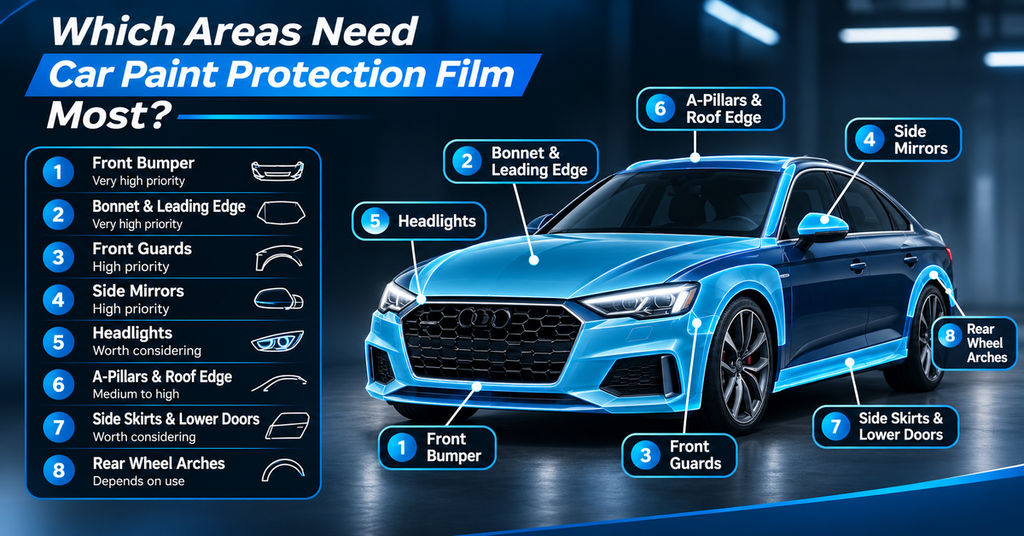
Not every panel receives the same level of exposure. For highway commuters and long-distance drivers, the front of the vehicle is generally the most practical place to start. If you’re considering paint protection for your vehicle, contact Seven Star Window to discuss your requirements and available protection options.
1. Front Bumper
The front bumper is one of the first areas to encounter stones, gravel, and road debris thrown up by vehicles ahead.
Its lower sections can be particularly exposed because they sit close to the road. Applying PPF to the bumper helps reduce the risk of small chips and surface marks affecting the painted finish.
Priority: Very high for regular highway drivers.
2. Bonnet and Leading Edge
The bonnet faces direct exposure to airborne debris while the vehicle is moving. The leading edge, in particular, can collect small stone impacts during regular motorway travel.
A partial bonnet kit covers a selected section, while full bonnet PPF protects the entire painted panel. The full option avoids leaving an exposed section of bonnet paint behind the film’s coverage line.
Priority: Very high, especially for vehicles used on long-distance journeys.
3. Front Guards
Front guards sit on either side of the bonnet and around the front wheels. Their forward-facing sections can be exposed to stones and debris.
Protecting both front guards alongside the bumper and bonnet creates more consistent coverage across the front of the vehicle.
Priority: High for drivers who frequently use motorways or travel behind larger vehicles.
4. Side Mirrors
Side mirrors extend beyond the main body panels, leaving their painted outer covers exposed to passing debris and minor surface contact.
Although they are relatively small, they can be noticeable when chipped. Mirror covers are often included in front-end PPF packages.
Priority: High for regular highway use.
5. Headlights
Headlight lenses are exposed to stones, insects, and environmental contamination. Depending on the vehicle and film product, suitable protective film may help reduce minor surface marks.
However, headlights are not painted body panels. Always check that the chosen film is designed and approved for the specific lens material and does not affect light output or visibility.
Priority: Worth considering as an additional protection area.
6. A-Pillars and Front Roof Edge
The A-pillars run along the sides of the front windscreen, while the leading section of the roof sits above the windscreen.
Both areas can receive impacts from airborne debris, particularly during highway driving. Drivers who regularly travel long distances may benefit from including these sections in an extended PPF package.
Priority: Medium to high, depending on driving conditions and vehicle design.
7. Side Skirts and Lower Doors
Side skirts and lower door sections can encounter debris thrown outwards by the tyres. This is particularly relevant when driving on roads with loose gravel or rough surfaces.
Extending PPF coverage to these areas can help protect paintwork that may otherwise be overlooked in a basic front-end package.
Priority: Worth considering for frequent long-distance drivers.
8. Rear Wheel Arches
The front-facing sections of the rear wheel arches can be exposed to stones and debris thrown up by the front tyres or surrounding traffic.
This area is often considered in extended or track-style PPF packages. It may be useful for drivers who regularly travel on roads with loose surfaces.
Priority: Depends on vehicle shape, tyre setup, and driving conditions.
Which PPF Coverage Option Should You Choose?
The right package depends on how often you drive, where you travel, and how much of the original paintwork you want to protect. Your budget also plays an important role, so it’s worth understanding the cost of paint protection film in Sydney before deciding on the coverage that suits your vehicle.
| PPF coverage | Commonly protected areas | Suitable for |
| Partial front | Selected sections of the bumper and bonnet | Drivers seeking targeted protection |
| Full front | Bumper, full bonnet, front guards and mirrors | Regular commuters and highway drivers |
| Extended coverage | Full front plus selected A-pillars, roof edge, side skirts or wheel arch areas | Frequent long-distance drivers |
| Full-body PPF | Most or all suitable painted exterior panels | Owners seeking broader paint protection |
Package names and inclusions vary between installers. Always ask for a panel-by-panel coverage list before choosing a package.
Partial PPF vs Full Front PPF: What’s the Difference?
Partial and full-front coverage are two common choices, but they offer different levels of protection.
| Factor | Partial PPF | Full Front PPF |
| Coverage | Selected high-impact sections | Complete selected front panels |
| Bonnet | Usually a partial section | Entire bonnet |
| Visible film edge | May be noticeable | Can be less noticeable with suitable installation |
| Protection area | More limited | Broader front-end coverage |
| Cost | Generally lower | Generally higher |
| Best suited to | Budget-conscious owners | Regular highway drivers and new-car owners |
For drivers who regularly use the M2 or M7, full-front coverage may be worth considering because it protects more of the bonnet and surrounding panels. However, the best choice still depends on the vehicle, budget, and expected use.
Expert Tips Before Installing Paint Protection Film
Before choosing a PPF package, consider these practical points:
- Inspect the existing paint: Chips, scratches, and previous repairs should be assessed before installation.
- Choose coverage based on your routes: Regular motorway driving may justify more front-end coverage than occasional local trips.
- Ask about film specifications: Check the film material, thickness, top-coat features, and manufacturer warranty.
- Understand the coverage map: Confirm exactly which panels and sections are included.
- Check installation quality: Proper surface preparation, clean application, and careful edge finishing all matter.
- Follow maintenance instructions: Use cleaning products and washing methods recommended by the film manufacturer.
A good installer should explain what the film can protect against and where its limitations begin.
Common PPF Mistakes to Avoid
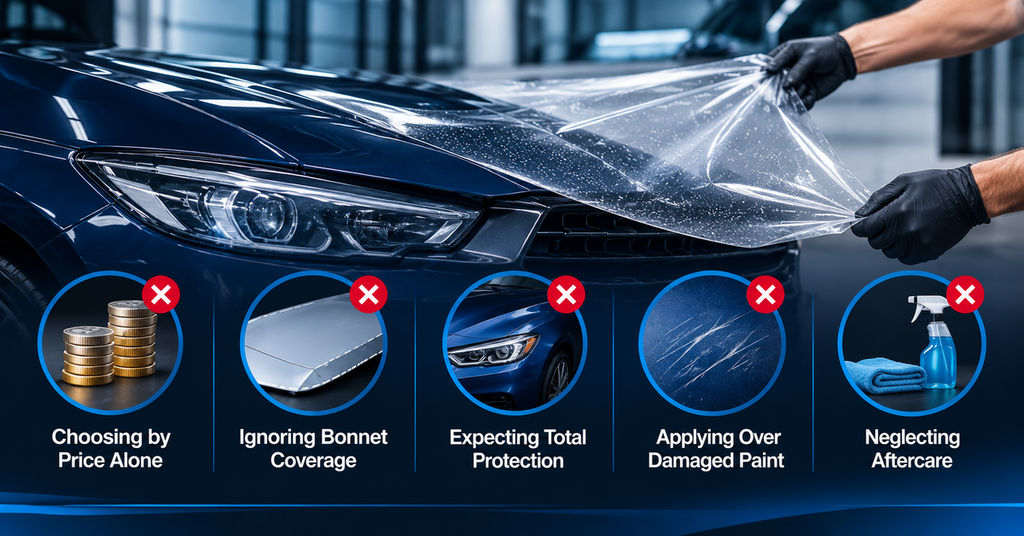
Choosing a package based on price alone: A cheaper package may cover fewer panels or use a different film. Compare the actual inclusions and product specifications.
Ignoring the bonnet coverage line: Partial bonnet film leaves some paint exposed. Ask where the film ends and whether the edge will be visible.
Assuming PPF prevents every type of damage: The film helps with certain impacts and surface marks, but it cannot prevent dents, major collisions, or all scratches.
Installing film over damaged paint without assessment: Existing defects may remain visible beneath the film. Any required paint repairs should be discussed before installation.
Neglecting aftercare: Incorrect washing methods or harsh chemicals may affect the film’s appearance and performance. Follow the manufacturer’s care instructions.
Conclusion
Choosing the right car paint protection film coverage starts with understanding how and where you drive. For most regular highway commuters, the front bumper, bonnet, front guards and side mirrors are sensible areas to prioritise. Drivers who frequently travel longer distances may also consider the A-pillars, roof edge, side skirts and rear wheel arch sections.
Full-front PPF offers broader coverage than a partial kit, but the right package depends on your vehicle, budget and exposure to road debris. Seven Star Window can help you explore vehicle paint protection options and understand how PPF differs from ceramic coating. Before making a decision, compare the coverage, film specifications, and installation details, so you know exactly what protection you’re choosing.
Frequently Asked Questions
It can be worthwhile for drivers who regularly travel at highway speeds, particularly when their routes expose the vehicle to loose stones and road debris. Full-front coverage is a common option because it protects several forward-facing panels.
PPF helps absorb and resist minor stone impacts, reducing the likelihood of chips reaching the original paint. However, the level of protection depends on the film, installation, and severity of the impact.
Full bonnet coverage protects the entire painted panel, while partial coverage protects only a selected section. If you frequently drive on motorways, full coverage may be worth considering to avoid leaving the rear section exposed.
Some ceramic coatings are compatible with PPF and can be applied over it, provided the coating manufacturer approves the combination. Ceramic coating can help with cleaning and surface maintenance, while PPF provides the physical impact barrier.

