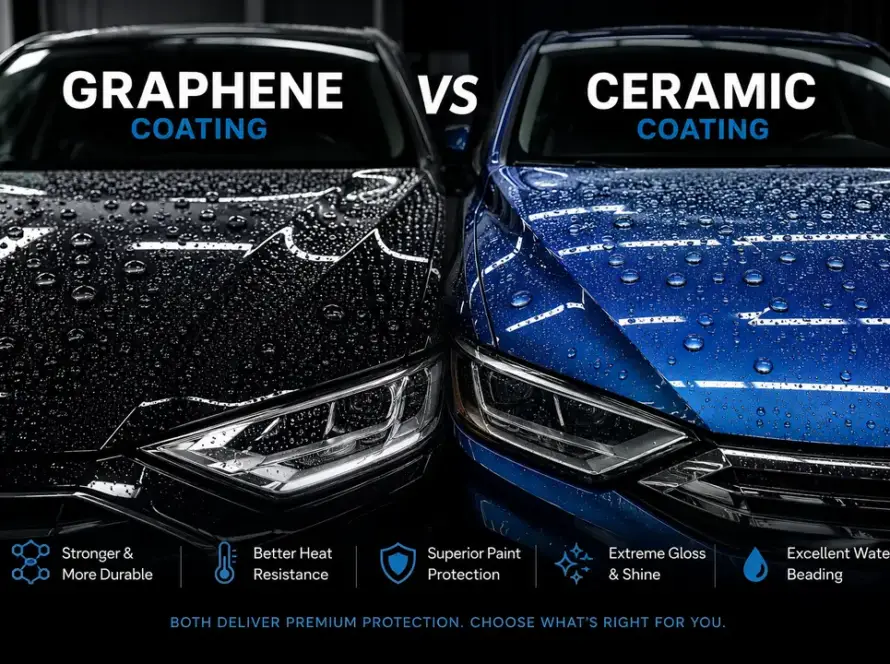
A car used every day faces more than the occasional wash and weekend drive. Daily commuting exposes its paintwork to road grime, bird droppings, changing weather, UV exposure, and repeated cleaning. If your vehicle spends most of its time outdoors, keeping the finish looking good can become a regular challenge.
Graphene coating for cars is one option for protecting exterior paint and making routine maintenance easier. But is it worth the extra investment for an everyday vehicle? This guide explains how it works, what it can realistically do, and when it makes sense for Sydney drivers. Seven Star Window provides graphene coating services in Rouse Hill and surrounding areas.
What Is Graphene Coating for Cars?
Graphene coating is a liquid paint protection product formulated with graphene or graphene-related materials, commonly graphene oxide, alongside other coating ingredients such as silica-based compounds and resins.
After application and curing, it forms a thin protective layer over the vehicle’s clear coat. The coating is designed to improve surface slickness, enhance gloss, and create hydrophobic properties that help water move away from the paint.
Unlike a traditional wax, a professionally applied coating is designed to provide longer-lasting surface protection. However, the performance depends on the particular product, paint preparation, application conditions, and maintenance.
It is important to understand that a graphene coating is not a physical film. It cannot stop a stone travelling at speed from chipping your bonnet or bumper.
Is Graphene Coating Worth It for Daily Drivers?
For many daily drivers, graphene coating can be a practical investment if the main priorities are easier washing, a glossy finish and additional protection against everyday environmental contamination.
Consider a vehicle used for commuting between Rouse Hill, Parramatta and Blacktown. It may collect road film during regular travel, sit in an exposed parking space throughout the day and encounter bird droppings or tree residue when parked outdoors.
A suitable graphene coating can make routine washing easier. Explore our professional graphene coating in Rouse Hill to learn more about available protection options.
However, it is not essential for every vehicle. If your car is inexpensive to maintain, spends most of its time in a garage, or is regularly replaced, a quality wax or paint sealant may be sufficient.
When graphene coating makes practical sense
It may be worth considering if you:
- Drive your vehicle most days and want easier routine cleaning.
- Regularly park outside in direct sunlight.
- Want to maintain the appearance of your factory paint.
- Frequently encounter road grime, dust, and environmental contaminants.
- Plan to keep your vehicle for several years.
- Prefer a longer-term paint protection option over frequent wax applications.
The decision should be based on your vehicle’s condition, usage, and budget rather than the coating’s name alone.
What Are the Main Graphene Coating Benefits?
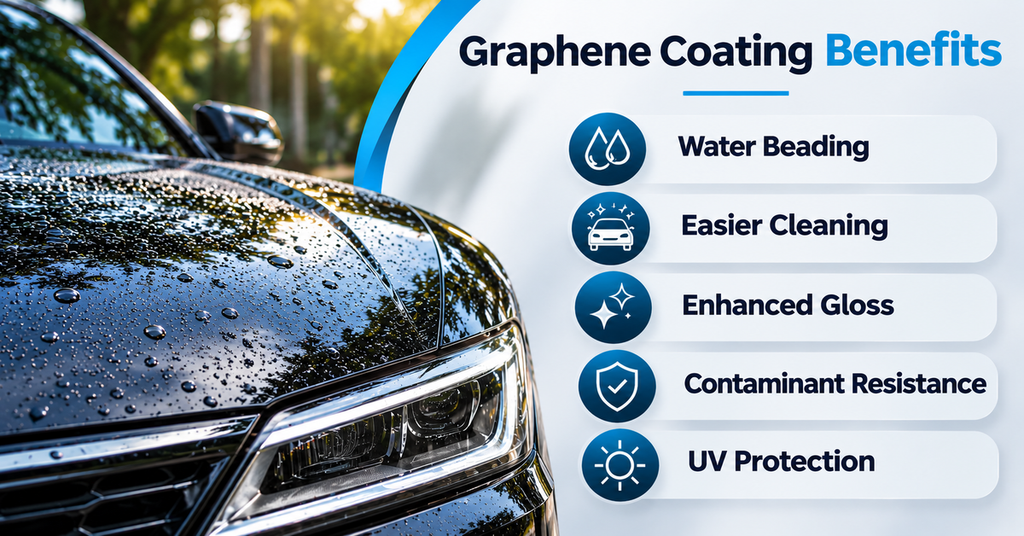
A graphene coating offers several potential advantages for everyday vehicle owners.
1. Hydrophobic Protection and Water Beading
One of the most noticeable graphene coating benefits is its hydrophobic effect. Water tends to form droplets or move across the treated surface rather than spreading evenly over it.
This behaviour can make it easier to rinse away loose dirt and reduce the amount of residue left behind during washing.
However, water beading is not a reliable measurement of the coating’s entire protective performance. A coating can lose some of its water-repellent behaviour as contamination accumulates, even when parts of the protective layer remain present.
2. Easier Everyday Cleaning
Daily-driven vehicles collect dust, road film, insects, and other contaminants. A smooth, water-repellent surface can make routine washing easier by reducing how strongly some dirt attaches to the paint.
This does not mean you can skip washing. Regular cleaning is still necessary to prevent contaminants from remaining on the surface for extended periods.
3. Gloss and Paint Appearance
Graphene coatings can enhance the gloss and visual depth of properly prepared paintwork.
The final appearance depends heavily on the condition of the clear coat underneath. Existing swirl marks, oxidation, and scratches may remain visible unless they are corrected before application.
4. Resistance to Environmental Contaminants
A suitable coating can provide a protective surface against everyday environmental exposure, including road grime, bird droppings, and some chemical contaminants.
It is still important to remove bird droppings and other aggressive contaminants promptly. No coating makes automotive paint immune to chemical damage.
5. Support Against UV-Related Deterioration
Vehicles regularly parked outdoors are exposed to sunlight and changing weather conditions. A quality coating can provide an additional protective layer over the clear coat.
However, the degree of UV-related protection varies by formulation. It should not be treated as a guarantee against fading or paint deterioration.
Graphene Coating vs Ceramic Coating vs Wax
Graphene coating is often marketed as an upgrade over conventional ceramic protection. In practice, the difference depends on the specific formulation and the quality of application.
| Feature | Graphene coating | Ceramic coating | Car wax |
| Main purpose | Surface protection and easier maintenance | Surface protection and gloss | Shorter-term surface protection |
| Water behaviour | Hydrophobic, product-dependent | Hydrophobic, product-dependent | Water-repellent |
| Gloss | Enhances paint appearance | Enhances paint appearance | Adds shine |
| Maintenance | Requires regular washing | Requires regular washing | More frequent reapplication |
| Longevity | Depends on product and care | Depends on product and care | Generally shorter |
| Cost | Often positioned as a premium option | Varies by package | Generally more affordable |
Which should you choose?
- Choose graphene coating if you want a premium coating option and its specific product characteristics suit your requirements.
- Consider ceramic coating if you want established liquid-applied paint protection with suitable product and installation options.
- Choose wax if you prefer a lower-cost option and do not mind applying protection more frequently.
Do not assume graphene automatically outperforms ceramic coating. Compare the actual product specifications, application process, expected maintenance and warranty conditions.
How Long Does Graphene Coating Last?
Graphene coating durability varies between products. There is no single lifespan that applies to every coating.
The following factors can influence how long it performs effectively:
- Surface preparation: Dirt, bonded contamination, and paint defects can affect coating adhesion and the final finish.
- Application quality: Uneven application, incorrect product use, or unsuitable conditions can affect the result.
- Curing conditions: The coating must be allowed to cure according to the manufacturer’s instructions.
- Parking conditions: Regular outdoor exposure can increase the demands placed on the coating.
- Washing habits: Harsh chemicals, abrasive materials, and poor washing techniques can reduce coating performance.
- Maintenance: Suitable maintenance products and periodic inspections help identify changes in surface behaviour.
A manufacturer’s advertised lifespan should be treated as a product-specific claim, not a guarantee that every vehicle will achieve the same result.
What Does Graphene Coating Not Protect Against?
Understanding the limitations is just as important as understanding the benefits.
Graphene coating is not designed to:
- Stop stone chips from highway driving.
- Prevent deep scratches or dents.
- Make the paint completely scratch-proof.
- Repair existing clear-coat damage.
- Eliminate the need for washing.
- Prevent every type of water spot or chemical mark.
If your vehicle regularly travels on motorways or roads with loose gravel, Paint Protection Film (PPF) may be a more suitable option for high-impact areas.
PPF creates a physical barrier over the paint, while graphene coating mainly provides surface protection, gloss, and water-repellent behaviour.
You can also explore our guide to graphene coating vs PPF to understand how these two protection options differ.
How to Maintain a Graphene Coated Daily Driver
A coating makes paint maintenance easier, but it does not make the vehicle maintenance free.
Follow these practical habits:
- Wash regularly: Remove accumulated dust, road grime and other contaminants before they build up.
- Use suitable car shampoo: Choose a pH-neutral product that is compatible with your coating manufacturer’s aftercare recommendations.
- Use clean wash equipment: Avoid dirty sponges, abrasive brushes and contaminated microfibre cloths.
- Remove bird droppings promptly: Don’t let aggressive contaminants remain on the paint unnecessarily.
- Dry the vehicle properly: Use a clean, soft drying towel to minimise water marks.
- Inspect water behaviour: Notice whether water beading or sheeting changes, but do not assume this alone means the coating has failed.
- Follow professional aftercare advice: Use recommended maintenance products and arrange inspections when needed.
For vehicles that are washed frequently, good washing technique is particularly important. Poor washing habits can still create swirl marks, even with a protective coating.
What Happens Before Graphene Coating Is Applied?
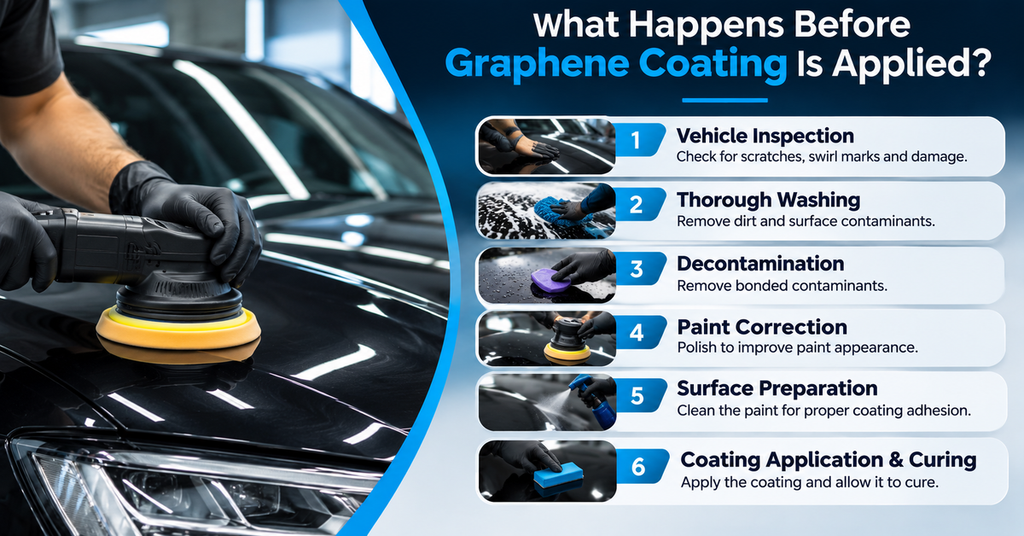
Professional application involves more than spreading a product across the vehicle.
A typical preparation process includes:
1. Vehicle inspection: The paintwork is checked for scratches, swirl marks, oxidation and existing damage.
2. Thorough washing: Loose dirt and surface contamination are removed.
3. Decontamination: Suitable methods are used to remove bonded contaminants that remain after washing.
4. Paint correction where required: Polishing may be recommended to improve the appearance of existing paint defects before the coating is applied.
5. Surface preparation: The paint is cleaned according to the coating manufacturer’s requirements.
6. Coating application and curing: The product is applied evenly and allowed to cure under the specified conditions.
This preparation matters because a coating does not automatically remove imperfections underneath it. In many cases, correcting the paint beforehand has a significant influence on the final appearance.
For more detail about professional coating preparation, see our guide on how ceramic car coating is applied.
Expert Tips Before Choosing Graphene Paint Protection
Before investing in graphene paint protection, consider these points:
- Ask which coating is being used: Request the product name and manufacturer information.
- Compare realistic durability claims: Ask what the advertised lifespan means and what maintenance is required.
- Check preparation inclusions: Find out whether washing, decontamination, and paint correction are included.
- Discuss your parking conditions: A vehicle parked outdoors may have different maintenance requirements from one kept in a garage.
- Understand the warranty: Ask what is covered, what is excluded, and whether scheduled maintenance is required.
- Consider your actual protection needs: If stone chips are your main concern, investigate PPF rather than relying on a liquid coating.
A professional assessment can help determine whether the vehicle needs paint correction before coating and which protection option is appropriate.
Common Graphene Coating Mistakes to Avoid
Choosing based only on the advertised lifespan: A longer advertised duration does not automatically mean better performance. Check the product details and conditions behind the claim.
Assuming the coating prevents scratches: Graphene coating is not a substitute for a physical impact-protection film.
Skipping paint preparation: Applying coating over contamination or visible paint defects can compromise the finish.
Expecting water beading to last forever: Surface contamination and maintenance can change water behaviour over time.
Using harsh cleaning products: Unsuitable chemicals and abrasive tools can affect the coating and the underlying paint.
Ignoring aftercare: Even premium coatings need appropriate washing and maintenance.
Conclusion
Graphene coating for cars can be a practical option for daily drivers who want a glossy finish, easier washing and additional protection against everyday environmental contamination. It may be particularly useful for vehicles regularly parked outdoors or driven through busy Sydney roads.
However, it is not a substitute for regular car care, and it will not prevent stone chips, deep scratches or impact damage. Product quality, paint preparation and correct aftercare all influence the final result.
Seven Star Window provides professional graphene coating in Rouse Hill, serving drivers across the Hills District and surrounding North West Sydney areas. If you are considering graphene paint protection for your daily driver, contact Seven Star Window to discuss your vehicle’s condition and suitable coating options.
Frequently Asked Questions
It can be worthwhile if you want easier washing, improved gloss, and additional protection against environmental contaminants. Its value depends on the vehicle’s condition, parking habits, budget, and how long you plan to keep the car.
It can provide a protective surface that helps make some contaminants easier to remove. However, bird droppings and tree sap should still be cleaned off promptly because they can damage automotive paint.
It may help water move away from the surface, but it does not eliminate water spots. Mineral-rich water can leave deposits when droplets evaporate, so proper drying and washing remain important.
Not automatically. Both are liquid-applied paint protection options, and their performance depends on formulation, preparation, application, and maintenance. Compare the actual products rather than relying on the coating category alone.