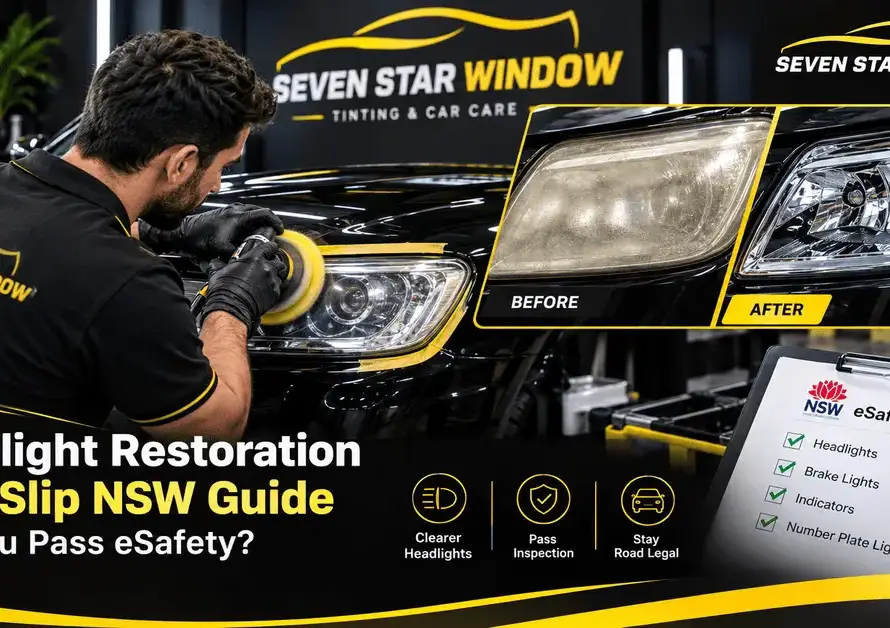
Headlights turn yellow or cloudy because of UV oxidation — sun exposure slowly breaks down the protective clear coat on the polycarbonate lens, leaving the plastic underneath exposed and discolored. It’s a chemical change in the material itself, not dirt or grime, which is why washing a hazy headlight never actually fixes it. The real fix is headlight restoration — removing the damaged layer and resealing the lens with a fresh UV-resistant coating.
This guide breaks down exactly what’s happening to your headlights, the specific factors that speed it up, and how to tell if you’re looking at a simple fix or something more serious.
The Plastic Behind the Glass-Like Shine

Most people assume headlight lenses are glass, like they were decades ago. Almost all modern vehicles actually use polycarbonate — a lightweight, impact-resistant plastic that’s much safer in a stone-chip or minor collision than glass ever was. The trade-off is durability against sunlight: polycarbonate is naturally vulnerable to UV radiation, so manufacturers apply a thin factory clear coat to protect it.
That clear coat is doing more work than people realize. Once it starts breaking down — usually a few years into the vehicle’s life — the raw polycarbonate underneath is directly exposed to sunlight, oxygen and airborne contaminants, and that’s when the yellowing actually begins.
What UV Oxidation Is Actually Doing to the Lens
“Oxidation” sounds abstract, but it’s a specific chemical process: UV radiation breaks the molecular bonds in the polycarbonate and its coating, and the material reacts with oxygen in the air, forming a yellowish, cloudy layer on the surface. It’s the same basic mechanism that fades outdoor plastic furniture or yellows an old phone case — except on a headlight, it also scatters and blocks light, which is the part that actually matters for driving.
This is why no amount of car washing, glass cleaner or wiping fixes it. You’re not cleaning a surface — you’re looking at degraded material that needs to be physically removed and resealed, not wiped away.
The Conditions That Speed It Up
Not every car’s headlights yellow at the same rate. A few specific factors accelerate the process:
- Direct sun exposure and outdoor parking — vehicles kept outdoors daily get far more cumulative UV exposure than garaged ones
- Climate and UV intensity — Australia’s strong UV index means local vehicles often show yellowing earlier than the same model overseas
- Road debris and micro-abrasion — small stone chips and grit gradually wear down the clear coat, giving UV easier access to the plastic underneath
- Pollution and airborne chemicals — exhaust residue, tree sap and general road grime contribute to surface degradation over time
- Vehicle age — factory clear coats have a limited lifespan regardless of care, so even well-maintained older vehicles will eventually show some haze
If your car spends most of its life parked outside in a sunny driveway, cloudy headlights aren’t a maintenance failure on your part — it’s simply the expected outcome of the material and the conditions.
Yellowing, Hazing and Fogging Aren’t Always the Same Problem

These terms often get used interchangeably, but they point to different issues:
- Yellowing — a discoloured, amber-ish tint across the lens surface; classic UV oxidation
- Hazing/clouding — a dull, matte, less-transparent look, often an earlier stage of the same oxidation process
- Fogging or visible moisture inside the lens — this is different. If you can see condensation or water droplets inside the headlight housing, that’s a seal failure letting moisture in, not surface oxidation, and restoration won’t fix it.
Telling these apart matters because they call for different solutions — one is a polish-and-reseal job, the other is a housing or seal repair. If you’re not sure which you’re looking at, it’s worth getting it properly assessed rather than guessing. See our comparison guide on Headlight Restoration vs Replacement for how to tell the difference.
Why This Isn’t Just a Cosmetic Issue
Oxidised headlights don’t just look tired — they genuinely reduce how much light makes it onto the road. A cloudy lens scatters and absorbs light rather than letting it project cleanly, which measurably cuts down visibility and reaction time at night. It’s one of those problems that’s easy to get used to gradually, since the change happens slowly enough that most drivers don’t notice how much worse their night visibility has become until it’s restored and the difference is obvious.
There’s also a compliance angle specific to NSW: headlight condition is assessed as part of a pink slip / eSafety check, so lenses hazy enough to significantly reduce light output can be flagged during inspection. If your rego renewal is approaching, it’s worth getting cloudy headlights looked at before the inspection date rather than risking a fail.
Can You Prevent It From Happening Again?
You can’t stop UV exposure entirely if your car lives outdoors, but you can slow the process considerably. Garaging the vehicle when possible, using a car cover for long outdoor stints, and — most importantly — applying a proper UV-resistant protective coating after a restoration all extend the time before oxidation returns. This is exactly why the sealing step matters so much in a professional restoration: it’s not just polishing away the damage, it’s rebuilding the protective barrier the factory coating used to provide.
Will This Keep Happening If I Fix It Myself?
Often, yes — and this is the most common follow-up problem we see. A lot of retail DIY kits remove the oxidised layer reasonably well but skip or under-deliver on the sealing step, so the bare polycarbonate ends up exposed to UV again almost immediately. If you’ve restored your headlights before and watched them yellow again within months, that’s very likely why. Our full breakdown on DIY kits vs professional service covers exactly where that gap comes from.
What Actually Fixes It
Professional restoration addresses the whole problem rather than just the symptom: the damaged outer layer is sanded away, the lens is polished back to clarity, and a proper UV-resistant coating is applied and cured to protect the surface going forward. Done properly, this restores both appearance and genuine light output — not just a temporary shine.
For the full process, benefits and pricing, see our complete guide: Headlight Restoration in Rouse Hill – Cost, Process & Benefits.
Get Your Headlights Properly Restored
If your headlights have gone yellow, hazy or dull, it’s a fixable problem — not a reason to consider replacing the whole assembly. Seven Star Window Tinting & Car Care provides professional headlight restoration across Rouse Hill, Kellyville, Blacktown, Nelson and the Hills District, starting from $60, including the UV-protective finish that actually makes the result last.
Frequently Asked Questions
What causes headlights to turn yellow?
UV radiation breaks down the factory clear coat and the polycarbonate lens underneath, causing a chemical reaction with oxygen that produces a yellow, discoloured surface. It’s material degradation, not dirt.
Can cloudy headlights be cleaned instead of restored?
No. Washing or wiping only removes surface dirt — the yellowing is beneath the surface, in the lens material itself, and needs to be physically sanded away and resealed to actually fix it.
Is headlight yellowing covered by car washes or detailing wipes?
No regular cleaning product reverses UV oxidation. Only a proper restoration process — sanding, polishing and resealing — addresses the underlying material damage.
Does headlight yellowing affect safety?
Yes. Oxidised lenses scatter and block light, reducing how far and how clearly headlights illuminate the road at night, which affects visibility and reaction time.
Can yellow headlights fail a pink slip or eSafety check in NSW?
Headlight condition is assessed during an eSafety check, and lenses hazy enough to significantly reduce light output can be flagged during inspection.
How do I know if it’s oxidation or a moisture problem?
Yellowing and surface haze are UV oxidation. Visible fog or water droplets inside the headlight housing point to a seal failure instead, which needs a different fix than restoration.
Will my headlights turn yellow again after restoration?
Not if a proper UV-resistant sealant is applied and cured correctly. Yellowing returning quickly usually means the sealing step was skipped or under-delivered, which is common with lower-grade DIY kits.