Thinking about tinting your windows but not sure how dark you’re actually allowed to go? You’re not alone. Window tint laws in New South Wales are strict, actively enforced, and catch out more drivers than you’d expect — usually because a tint shop cut corners or a DIY kit was applied without checking the numbers properly.
The good news is that NSW’s rules are actually some of the clearest in the country once you understand how they work. In this guide, we’ll break down exactly what’s legal, what isn’t, what happens if you get it wrong, and how to make sure your car stays both stylish and street-legal.
What Is VLT and Why Does It Matter?
Every window tint law in Australia is built around one measurement: Visible Light Transmission (VLT). This is the percentage of light that’s allowed to pass through your window once the tint film and the glass are combined.
Here’s the part most drivers get wrong: the legal VLT percentage isn’t just about the film you buy — it’s about the combined result of the factory glass plus the film on top of it. Most factory glass already lets through somewhere between 70–80% VLT on its own. So if you apply a film rated at 35% VLT over glass that’s already tinted from the factory, your final result can drop well below the legal limit without you realizing it.
This is exactly why a proper installer measures your glass with a VLT meter before choosing a film, rather than just going by the percentage printed on the box.
NSW Legal Window Tint Limits
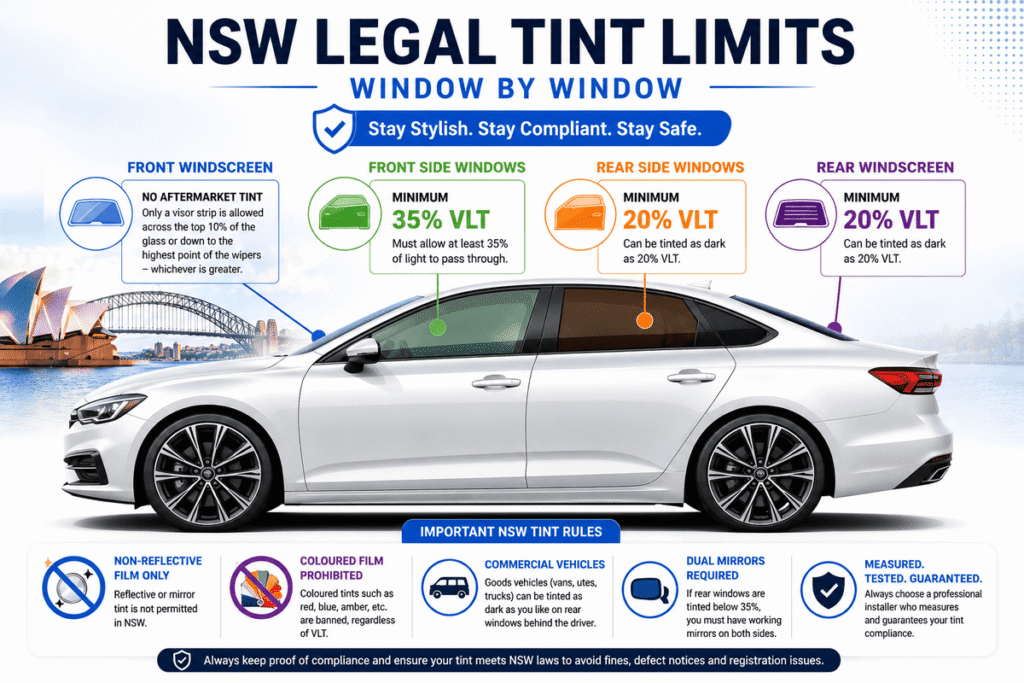
Under the NSW Road Transport (Vehicle Registration) Regulation, here’s what’s currently permitted:
- Front windscreen
No aftermarket tint is allowed on the main windscreen. The only exception is a visor strip across the top 10% of the glass, or down to the highest point the wipers sweep — whichever is greater.
- Front side windows
Must allow a minimum of 35% VLT. These are the windows directly beside the driver and front passenger, and they’re held to the strictest standard because they affect the driver’s direct line of sight and how visible the driver is to police and other road users.
- Rear side windows and rear windscreen
Can be tinted as dark as 20% VLT. This is where most of the “look” of a tint job comes from, and it’s why rear windows are usually noticeably darker than the fronts on a compliant vehicle.
- Reflective and coloured film
NSW does not permit reflective or mirror-like tint film at all, and coloured films such as red, blue or amber are banned outright, regardless of VLT percentage.
- Commercial and goods vehicles
Vans, utes, trucks and similar vehicles designed to carry goods — where visibility through the rear isn’t essential for safe driving — are exempt from the rear VLT minimum and can be tinted as dark as the owner likes behind the driver. This exemption does not extend to SUVs or passenger wagons.
Vehicles without a working rear-vision mirror If your rear windows are tinted below 35% VLT and you don’t have functioning exterior side mirrors on both sides, this is also a compliance issue — dual mirrors are required once you go past that threshold.
What Happens If Your Tint Is Illegal?
This isn’t a “maybe you’ll get a warning” situation. NSW Police and Transport for NSW inspectors carry handheld tint meters and enforcement is active, particularly around registration renewal time and random roadside checks.
If your tint doesn’t meet the legal VLT minimums, you’re looking at:
- An on-the-spot fine — currently in the hundreds of dollars, plus demerit points
- A Defect Notice — this can stop you from legally driving the vehicle until it’s fixed
- A failed registration inspection — meaning you can’t re-register until the tint is corrected
- Potential insurance complications — some insurers can query non-compliant modifications during a claim
The cost of having illegal tint stripped and redone almost always ends up higher than getting it right the first time. It also means paying for the removal, the labour, and the new film all over again — versus doing it properly once.
Medical Exemptions
If you have a genuine medical condition that requires darker tint than the standard limits allow — certain skin or eye conditions, for example — you can apply for an exemption. If approved, you’ll receive a formal exemption notice specifying the permitted VLT and which windows it covers. This notice needs to be carried in the vehicle at all times, and your vehicle may still need to pass a separate safety inspection. Importantly, you should never apply darker film in anticipation of approval — the exemption needs to be granted first.
Common Mistakes Drivers Make
- Assuming the film percentage is the final result.
As covered above, factory glass tint stacks with your film. A “35% film” on already-tinted factory glass can easily test below the legal minimum.
- Trusting DIY tint kits without a compliance guarantee.
Pre-cut kits sold online rarely specify the true combined VLT for your specific vehicle, and there’s no professional measurement or certificate to fall back on if you’re pulled over.
- Not getting proof of compliance.
A reputable installer will provide a written record of the film used and the final tested VLT for each window. Without this, you have no evidence to show an inspector if there’s ever a dispute about your tint.
- Choosing a shop based on price alone.
The cheapest quote often reflects cheaper film that bubbles, fades, or peels early — and in some cases, hasn’t actually been checked against NSW’s legal requirements at all.
How Seven Star Window Keeps You Compliant
At Seven Star Window, every tint installation is measured with a professional VLT meter before and after application, so you know exactly where your vehicle sits against NSW law — not just what the film box claims. We only use premium, non-reflective film that meets NSW standards on front and rear windows, and we’re happy to talk you through exactly what percentage suits your car, your privacy preferences, and the legal limits together.
Whether you’re after maximum UV and heat protection, extra privacy, or simply want your car looking sharp, we’ll make sure it’s done right — cleanly installed, bubble-free, and fully road-legal from day one.
Frequently Asked Questions
Is 20% tint legal in NSW?
Yes, but only on rear side windows and the rear windscreen. Front side windows must stay at 35% VLT or lighter — 20% film on the front windows would be illegal.
Can you tint your windscreen in NSW?
Only the top 10% of the windscreen (or down to the wiper sweep line, whichever is lower) can be tinted, and only with a non-reflective visor strip. The rest of the windscreen must remain untinted.
What’s the darkest legal tint in NSW?
20% VLT is the darkest legal option, and it only applies to windows behind the driver. Front windows are capped at 35% VLT.
How much is the fine for illegal window tint in NSW?
Fines currently run into the hundreds of dollars along with demerit points, plus you may receive a Defect Notice preventing you from driving the vehicle until it’s fixed.
Does window tint affect car insurance in NSW?
Non-compliant tint can complicate an insurance claim if it’s found to breach vehicle regulations, so it’s worth keeping proof that your tint was professionally installed and compliant.
Ready to Tint Your Windows the Right Way?
Skip the guesswork and the risk of a fine. Book a free quote with Seven Star Window and we’ll fit your vehicle with premium, fully compliant window tint — built to look sharp and pass inspection.